
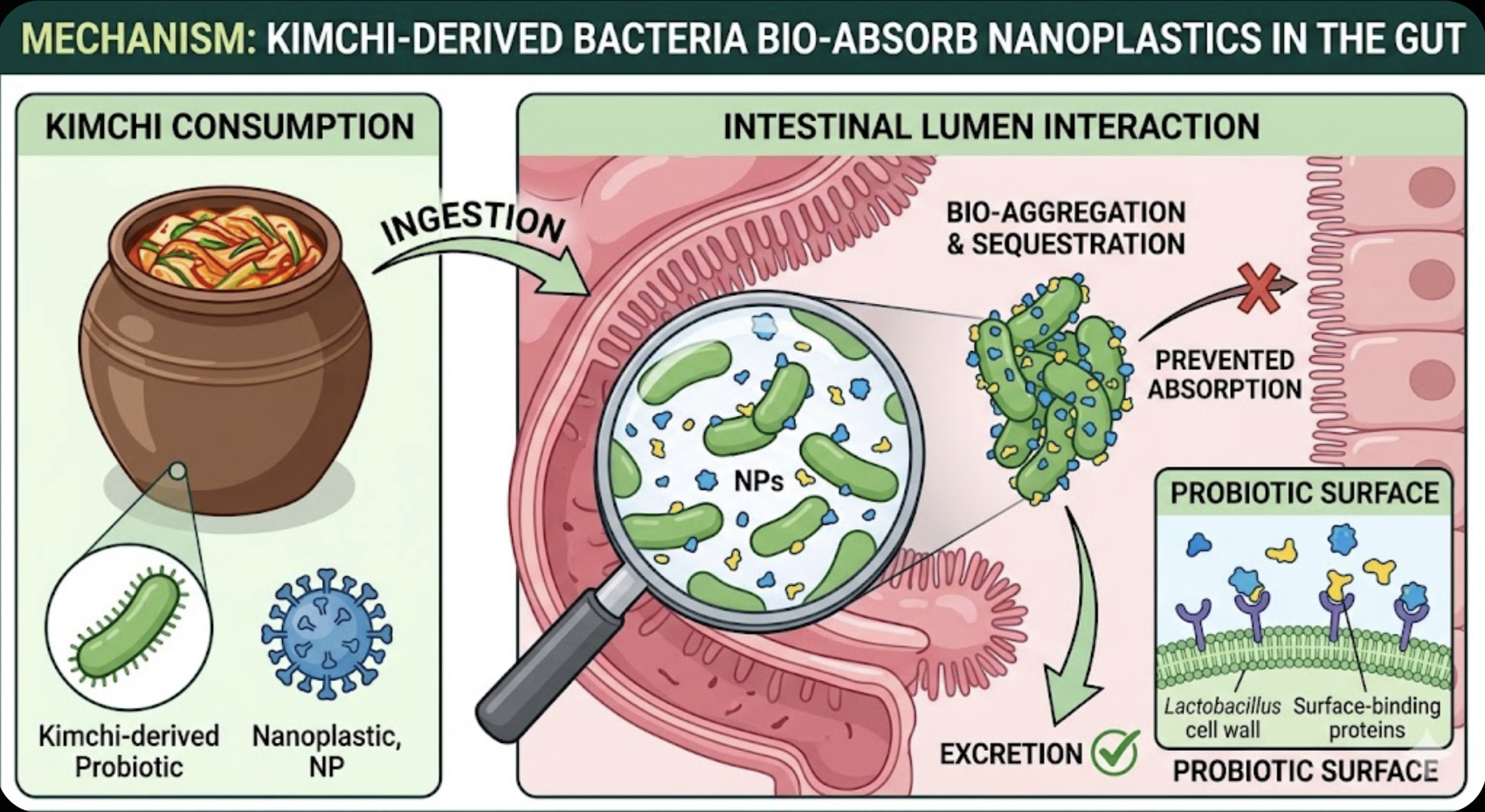
吃泡菜很可能可以幫助防止食物中奈米塑膠對健康的有害影響,功效來自泡菜中的兩種乳酸菌 Leuconostoc mesenteroides 和 Latilactobacillus sakei。
Dr. Rhonda Patrick 昨天 (2026-04-03) 在付費會員郵件中分享的一個最新科學發現,根據的是這個月剛在 Bioresource Technology 發表的一篇由一群南韓科學家發表的文獻。文獻連結在最下,只是一篇摘要 (Abstract),全文需付費,但大家可以看 Dr. Patrick 的重點解說,我幫大家把 Rhonda 的說明翻成中文,原文放在中文後面。
DR. Rhonda Patrick的重點詮釋:
微小的塑膠顆粒現在存在於食物、水中,甚至存在於人體內,這引起了人們對它們如何影響健康的擔憂。 在一項新的研究中,科學家們探討了食物衍生的細菌是否可以幫助捕獲奈米塑膠並促進它們從體內被排出體外。
研究人員檢查了從泡菜中分離出來的兩種乳酸菌:Leuconostoc mesenteroides CBA3656 和 Latilactobacillus sakei CBA3608。 他們將這些細菌暴露在「聚苯乙烯奈米塑膠」(尺寸小於1微米的極小的塑膠顆粒)中,並測量了細菌在不同實驗室條件下結合和去除這些顆粒的效率。 他們還評估了無細菌小鼠的 Leuconostoc mesenteroides,使研究人員能夠在不受其他微生物干擾的情況下分離出細菌和奈米塑膠之間的直接相互作用。
- 在典型的實驗室條件下,包括中性pH值和體溫,這兩種菌株都迅速捕獲了奈米塑膠,但Leuconostoc mesenteroides在大約30分鐘內達到接近最大效能,而Latilactobacillus sakei大約需要60分鐘。
- 在較高的塑膠濃度下,Leuconostoc mesenteroides 保持了強勁的效能,而 Latilactobacillus sakei 的效率急劇下降。
- 在廣泛的pH值和溫度下,這兩種菌株仍然有效,儘管Latilactobacillus sakei 在極端酸度和高溫下表現略好。
- 顯微鏡影象顯示,奈米塑膠附著在細菌細胞的外部,而不是進入它們。
- 在模擬腸液中,Leuconostoc mesenteroides 保留了相當大的結合能力,而 Latilactocillus sakei 失去了大部分的有效性,表明在人體條件下的適用性更強。
- 給予 Leuconostoc mesenteroides 的無菌小鼠在糞便中排洩的奈米塑膠比未經處理的對照組多,這表明腸道吸收減少。
實驗表明,這些細菌將奈米塑膠與其表面結合,這表明顆粒保持完整,而不是被分解。這一點很重要,因為「降解」未必等於「促進消,因為較小的碎片或副產品仍然可以被吸收,而附著在細菌上的完整顆粒更有可能透過腸道並被排洩。
經過治療的小鼠在糞便中排洩了更多的奈米塑膠,但沒有測量內臟器官中的奈米塑膠水準,因此目前仍不清楚經過治療小鼠和未治療小鼠之間的組織暴露有何不同。 由於小鼠沒有細菌,並且缺乏正常的腸道微生物群落,因此也不確定細菌在存在許多其他微生物的典型腸道中是否有效。 然而,如果在人體臨床試驗中得到證實,特定的益生菌補充劑或簡單地吃泡菜和其他發酵食品很可能可以幫助防止奈米塑膠對健康有的害影響。
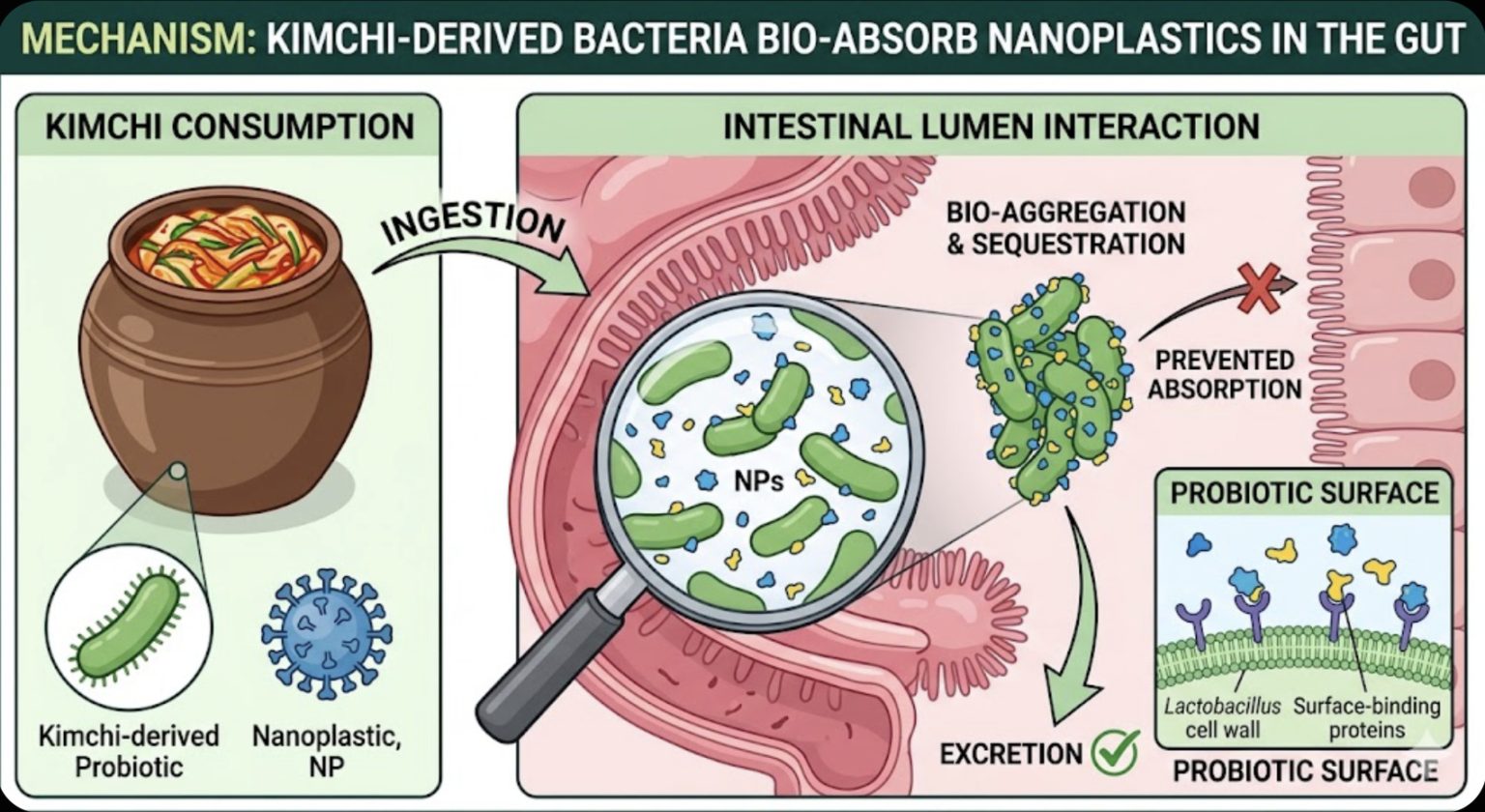
Tiny plastic particles are now found in food, water, and even inside the human body, raising concerns about how they affect health. In a new study, scientists explored whether food-derived bacteria could help capture nanoplastics and promote their removal from the body.
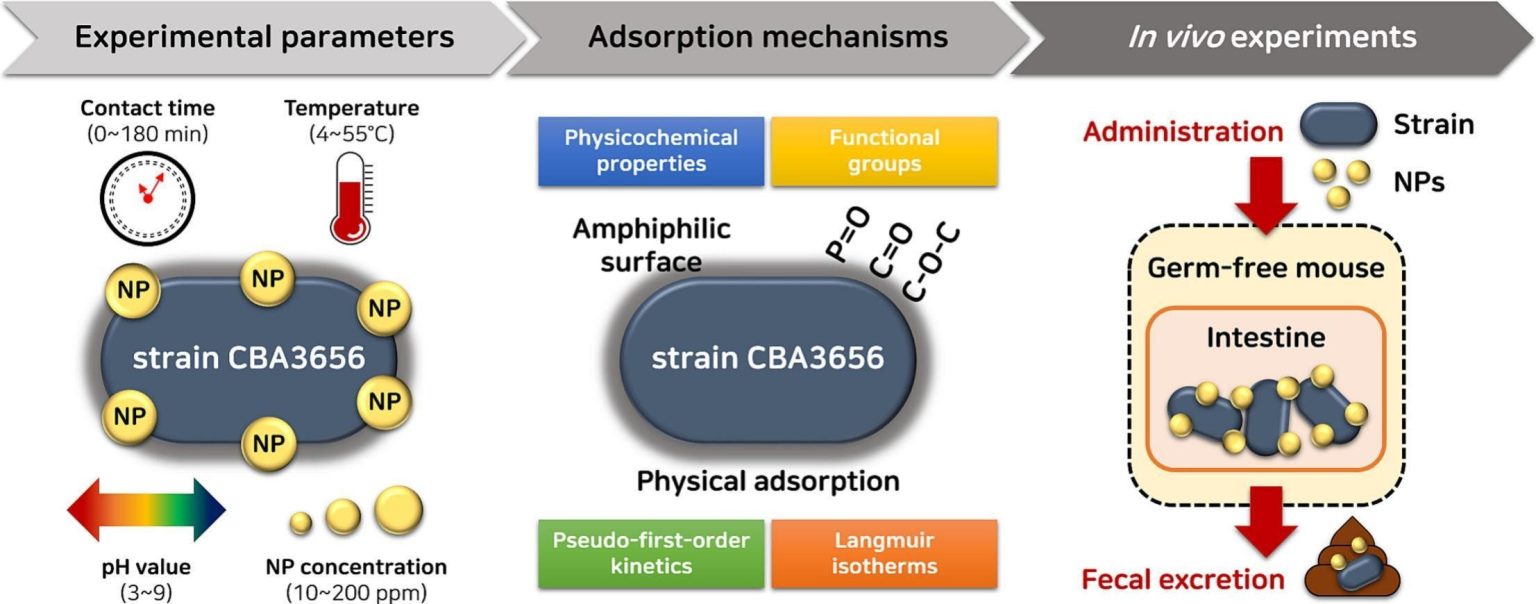
The researchers examined two lactic acid bacteria isolated from kimchi: Leuconostoc mesenteroides CBA3656 and Latilactobacillus sakei CBA3608. They exposed these bacteria to polystyrene nanoplastics (extremely small plastic particles under 1 micrometer in size) and measured how effectively the bacteria could bind and remove these particles under different laboratory conditions. They also evaluated Leuconostoc mesenteroides in germ-free mice, allowing the researchers to isolate the direct interaction between the bacteria and nanoplastics without interference from other microbes.
- Under typical laboratory conditions, including neutral pH and body temperature, both strains rapidly captured nanoplastics, but Leuconostoc mesenteroides reached near-maximum performance within about 30 minutes, while Latilactobacillus sakei took about 60 minutes.
- At higher plastic concentrations, Leuconostoc mesenteroides maintained strong performance, while Latilactobacillus sakei showed a sharp drop in efficiency.
- Across a wide range of pH levels and temperatures, both strains remained effective, although Latilactobacillus sakei performed slightly better under extreme acidity and heat.
- Microscopy images showed that nanoplastics attached to the outside of bacterial cells rather than entering them.
- In simulated intestinal fluid, Leuconostoc mesenteroides retained substantial binding ability, while Latilactobacillus sakei lost most of its effectiveness, indicating greater suitability under conditions found in the human body.
- Germ-free mice given Leuconostoc mesenteroides excreted more nanoplastics in their feces than untreated controls, suggesting reduced absorption in the gut.
The experiments show that these bacteria bind nanoplastics to their surfaces, suggesting that the particles remain intact rather than being broken down. This is relevant because degradation may not promote elimination, as smaller fragments or byproducts could still be absorbed, whereas intact particles attached to the bacteria are more likely to pass through the gut and be excreted.
Treated mice excreted more nanoplastics in their feces, but nanoplastic levels in internal organs were not measured, so it remains unclear how tissue exposure differed between treated and untreated mice. Because the mice were germ-free and lacked a normal gut microbiome, it is also uncertain whether the bacteria would be as effective in a typical gut with many other microbes present. However, if confirmed in human clinical trials, specific probiotic supplements or simply eating kimchi and other fermented foods could help protect against the harmful effects of nanoplastics.
Ref. Efficient biosorption of nanoplastics by food-derived lactic acid bacterium – Bioresource Technology, Volume 447, May 2026, 134234, Kimchi Functionality Research Group, World Institute of Kimchi, Republic of Korea
https://www.sciencedirect.com/science/article/abs/pii/S0960852426003159
